Tuesday, June 14, 2011

Moving On: Fourier Series

NewImage


Well, its about that time to start thinking about putting this blog to rest.  I do this for a couple of reasons:

1.  It takes a ton of time to research each topic.
2.  It takes a ton of time to figure out how to "translate" each topic is a way normal humans can understand.
3.  My appointment as a visiting professor is now up and I'm returning back to the world of engineering.
4.  There are a ton of science bloggers out there who have more free time on their hands than I do.

With that being said, I plan to hone my focus more.  I've decided to concentrate in the future on the best way I tend to learn...visually.  As we all know, psychiatrists tend to lump everyone into 4 types of learners:  Visual, Auditory, Read/Write and Tactile.  For some reason, science academia chose to focus on auditory and read/write learners with lectures, note taking and textbooks.  This is one of the reasons academia fails so spectacularly in science education: a large majority of people are visual/tactile learners.  I have insisted many times that EVERYONE can fully understand science and math, the problem is that it is presented in the wrong format which has, unfortunately, been institutionalized by academia.  If there is any group that innovates slower than molassas, its an academic faculty.
I've been toying with the idea of "Visual Math" leading up to "Visual Science" as a future blog endeavor.  Mostly because these types of learners are traditionally underserved, and also because that is the type of learner I am myself.

I will leave you with an clear example:  Fourier Series.


Here is the way a well known and respected engineer attemps to explain a fourier series in a well known engineering manual:

"Any periodic waveform can be written as the sum of an infinite number of sinusoidal terms, known as harmonic terms.  Such a sum of terms is known as a Fourier Series, and the process of finding the terms is Fourier Analysis.  Since most series converge rapidly, it is possible to obtain a good approximation to the original wave-form with a limited number of sinusoidal terms."

-Lindeburg, "Mechancial Engineering Reference Manual"

To a read/write or even auditory learner, this may work fine.  For the majority of us however, this explanation probability leaves your eyes watering, ears bleeding or wanting to through the text out your window.

Now let us contrast Lindeburg's written explanation with the following visual explanation:


Now I bet that makes MUCH more sense to most people.  If you now go back and read Lindeburg's explanation, it will also make more sense.  For most people, the why's of the science need to be illustrated visually before one can move into the details.  A fundamental failing of science education that I hope to address with a new blog.

Wednesday, February 2, 2011

Some Perspective...

Ever wonder what the other planets in our solar system would look like if they were as close to us as the moon?


You need to install or upgrade Flash Player to view this content, install or upgrade by clicking here.

Tuesday, February 1, 2011

Massive Storm Moving Across the US

As seen from orbit.  Not a bad time to be in Florida...


snowstorm from space.JPG

Friday, January 21, 2011

Gummy Bears and Chemistry Make for Great Science

Posted for Lesley, whom I am sure will very much enjoy this...


Wednesday, January 19, 2011

The Luckiest Friday the 13th You Will Ever Have

Apophis is the name given to asteroid 99942. Apophis is also the greek word for "the destroyer". I'm not sure who came up with the name, but its another case where either scientists or the press can be rather irresponsible in the nomenclature.
Here's Neil Tyson discussing this remarkable event from a few years ago:


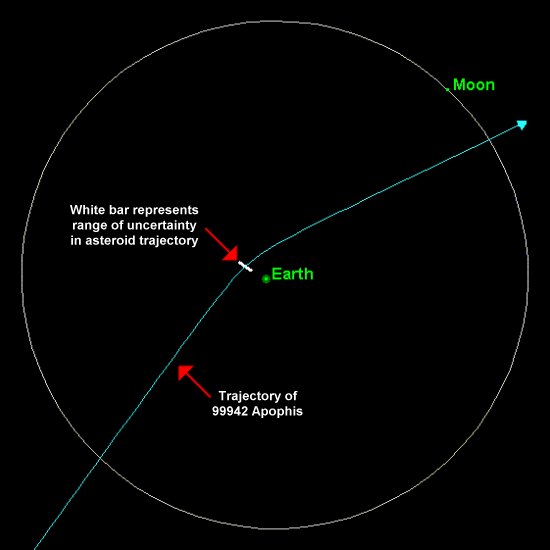
The good news is that Apophis will not hit the Earth on April, Friday the 13th, 2029. In fact, it will be a once in a lifetime event for us all to witness. The following picture will help illustrate just how close apophis will come to hitting Earth:
apophis-2029.jpg
The concerning aspect of Apophis is what happens after 2029. The "keyhole" Dr. Tyson talks about is a worst case scenario in which case Earth WILL get hit in the year 2036, which would result in widespread destruction of the west coast of the US. The chances that Apophis hits this "keyhole" is 1 in 250,000. A rather remote possibility. However, keep in mind your chances of getting hit by lightning are 1 in 500,000. Therefore this is a concern for scientists. It could be an even bigger concern in further out years and its eventual contact with Earth may just be a matter of time.
No matter what happens, at the very least, humanity will have at least 7 years warning to engineer a solution.
But, on April, Friday the 13th, 2029, look up at the sky and count your lucky stars that Apophis' orbit isn't even slightly different.

Thursday, January 13, 2011

Learn Something Today: The Fear of Numbers

Numbers can seem scary to lots of folks, but they needn't be any more intimidating than letters.  Equations need not be any more confusing than sentences.  In the ancient world, less than 1% of society was educated, but within this 1%, nearly all were equally versed on both language and math.  Today, the country's literacy rate is at all time highs while its math literacy rate continues to drop.  There is no reason for this.

There are four (4) basic types of numbers:

1.  Whole Numbers (example: 42).  These are the oldest of numbers and date back over 2500 years to ancient Greece.  To the greeks at this time, the number "1" (one) had a different meaning than we use today.  They considered "1" as a whole unit.  Numbers to them would be things that "make up" or "compose" the complete unit.

At this time however, it became important for shepherd's to be able to understand a convey the size of their flocks for business purposes.  They needed a way to describe size by numbers, this is where whole numbers were born.  The limits of "counting" at this time were 1, 2, perhaps 3, and then "flock" or "a lot".  As time progressed, more and more "counting" numbers were added to the Greek numeral system.

These numbers were not meant to be divided.  There was no need for it.  A "divided" cow wasn't worth anything because it would be dead.  Therefor, most common ancient greeks had no understanding of things like fractions.

Some famous shepherds:
mass_effect_shepard1_1195682359.jpg
lost matthew fox.jpg
Shepherd-of-Psalm-23.jpg


Eventually, the ancient greeks realized a problem though:  there was no number, either Whole or Rational that would describe certain geometric shapes.  For example, Pythagorus could not find a number that would be the exact ratio between a circle's circumference and area, otherwise known as "pi".  The ancients also knew of another weird ratio call the golden mean that seemed to keep occurring everywhere in nature, yet no one could figure its exact "number."  For these reasons, greek mathematicians had to develop the idea of "irrational numbers".

(Much, much later, the decimal system (example: ".5" is the same as "1/2") was developed which conveys rational numbers in an even more simplified form.)

3.  Irrational Numbers ("Pi", certain "square roots"). Rational and Irrational numbers are a case study into how math and science really needs to learn to update its terms as times change.  If you are confused by the descriptions "rational" or "irrational", you are not alone.  Today, its hard to think of any number not being "rational".  Even more so, why even label a "fraction" as rational?  The reason we have this descriptive confusion is based on time:  2500 years ago, there was a very good reason the greeks found some numbers to be rational, and others irrational.

The Greeks knew the numbers of Pi and the Golden Mean had to exist.  They were real and could be "made".  Circles were common.  Shapes and architecture commonly used the golden mean, so how could this ratio not exist?  It didn't make sense to them, hence to the ancient greeks, these numbers were not rational, but irrational.  In fact, they were considered so irrational at the time that Pythagorus, the most famous mathematician of his age, was said to have thrown one of his students overboard after the student proposed the idea of irrational numbers while on a voyage.
zpage174.gif
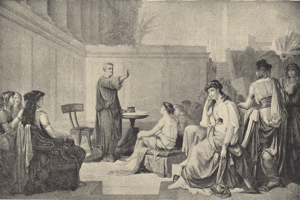
Pythagorus being a bore in math class 2500 years ago

The rule of identifying irrational numbers became much easier after the invention of the decimal system. A number is irrational if it has a non repeating, yet infinite decimal.  For example "Pi" is approximated at 3.14.  But this is not the exact value of Pi.  It can be further refined as 3.1415926535, yet even this is not correct.  In fact, Pi has been calculated to extend the decimal out to thousands of places.  The truth is, there is no exact number of Pi.  The decimal places stretch out to infinity.  If you ponder this a little, you too, may feel a little bit of the ancient greek's frustration and consider it "irrational" as well.

4.  Imaginary Numbers ("4i" or "12i").  These are the weirest of all numbers.  Here again, the term "imaginary" is not terribly accurate or helpful in today's context.  A better term would be "invented".  These numbers do not exist.

Imaginary numbers consist of a real number (ie, whole and rational numbers), and an "invented" number represented as "i".  "i" is simply the square root of -1, a number that does not exist.  Its kind of like trying to divide a number by zero, its impossible.  However, in some fields of science and math, calculations become much easier to deal with and more efficient if "i" really did exist.  Therefor, we separate the "real" part fromt he "invented" part.  In most cases, these numbers tend to meaningless unless you are dealing with vectors (to be covered later).

As a general summary from wikipedia:

"For most human tasks, real numbers (or even rational numbers) offer an adequate description of data. For instance, fractions such as ⅔ and ⅛ would be meaningless to a person counting stones, but essential to a person comparing the sizes of different collections of stones. In the same way, negative numbers such as –3 and –5 would be meaningless when measuring the mass of an object, but essential when keeping track of monetary debits and credits[2]. Similarly, imaginary numbers have essential concrete applications in a variety of scientific and related areas such as signal processing, control theory, electromagnetism, fluid dynamics, quantum mechanics, cartography, and vibration analysis."

...as you can see...there is nothing to be afraid of here.  Once you know the context, numbers are pretty easy to understand.

Monday, January 10, 2011

Science Provides Real, Tangible Optimism

A tip of the hat to rgower over at reddit for this.  NASA could use a good PR campaign right now.

Friday, January 7, 2011

Inspiration in Science

The beginnings of semesters are always interesting times.  One of the great aspects about academia that tends to get lost in the outside world:  the sense of a new beginning.  Back when I was in college, no matter how hard or bad a semester might have been, there was always that next semester which presented an opportunity to take a breather, get up, dust off and get ready to prove the world wrong.  Its a view I try to impress on my engineering student's at each semester's start.

This semester, one student in particular asked me about inspiration, and where I would find it at such times.  I find that inspiration in life with vary from person to person.  Part of if comes from having a passion about what you are doing.  However, even though that passion may exist, its still usually not enough to get through a lot of the work and tedium that may come with even the most adventurous or exciting jobs (even rock stars have to worry about stuff like legal contracts, management and business).

So besides my own interest in science...music is usually one of my greatest sources of inspiration.  Now, in my own personal opinion, today's music is at an all time low when it comes to quality, depth and creativity (my apologies to those who hear me complain about it way too much).  However, there are bright spots still out there.  

Postrock, Mogwai in particular, is an example of a band who always gets my science side going.  

Besides paying tribute, Mogwai's video for "stanley kubrick" is a rare feat of being wondrous, creepy, mysterious, historical and humorous all at the same time:


And one the best songs ever composed:  New Paths to Helicon Part 1:


Thursday, December 16, 2010

Math Does Not Equal Calculating

I have one question for anyone who has taken, or is taking calculus:  Can you explain what a Limit is?

I have asked this question literally dozens of times to engineering upperclassmen and graduate students.  Every single time its easy to see from their tortured attempts at an explanation that they have no real idea what a limit is in calculus.  They can integrate problems left and right, but they have virtually no idea why they are integrating something or what its purpose is.  

This is a fundamental failure of math education in this country.  We teach people how to calculate.  We don't teach people math.  

The fact is, calculations are a thing of the past.  Virtually all calculations performed in real world problems are automated with computers.  If memorization is the lowest form of learning, calculating is the lowest form of math.  It teaches nothing of importance other than how to follow a strict process to solve an over simplified problem no one will ever see in the real world.  And after 12-16 years of teaching math, no one has an idea WHY they are doing any of the calculations in the first place.

So I'll let you in on a little secret that most engineers eventually learn after college:  your math classes, and most of your math professors are a waste of time.  Most engineers don't really "understand" math until they start using it in the real world.  They quickly realize their schooling left them totally unprepared for what really matters:  learning how to correctly APPLY math (which is only a tool) to real world problems.

So let me answer that first question for you.  What is a limit?  Well, what is the smallest number of sides any shape can have?  One side only makes a line, not a shape.  Two sides will either make one or two distinct lines, again, not a shape.  A triangle, with three sides, is the shape with the least number of possible sides.  Four sides?  A rectangle.  eight sides?  An octagon...and so forth.

So what happens to a triangle, if we keep adding sides to it...over and over and over again.  Well, there is a limit that you will reach where your are no longer changing the shape of the object in any meaningful way.  Any idea what shape you will be left with?

A circle!  So, as you start to add sides to a triangle, from originally just 3 sides, to an infinite number of sides, the solution you will be left with is a almost perfect approximation of a circle. 

THATS IT!  That is the meaning and reason behind a limit.  There is no magic.  No black box.  Its simply a math trick that will allow you to come as close as possible (the limit) to the true shape of a circle, starting with something completely known...a triangle.

(Of course, limits can be applied to all kinds of things other than circles and triangles...things that exist in real life...like imperfect curves or surfaces...)

Tuesday, December 14, 2010

Saying Goodbye to Humanity

My apologies for the dirth of updates over the last few months.  An infant at home and an unusually busy semester load will do that to you...

I felt compelled to break my silence by an update on Voyager 1 that I read over at Bad Astronomy recently.  Since I have been wanting to post about the Voyager spacecraft for a while, now is the perfect time.

Voyager 1 was a NASA probe launched in 1977 to explore Jupiter and Saturn at a distance never before possible.  After providing some of the most fantastic science ever about these two monster planets, Voyager 1 slowly became something altogether different:  the ambassador of the entire history of our planet.

Recently, Voyager 1 reached a zone astronomers refer to as the "Heliosheath".  The picture below helps illustrate where this area is.


Basically, this is an area of space around our solar system where the solar wind from our sun no longer blows.  Voyager 1 has now officially said goodbye to our sun forever.  In a few years, she will leave the Helioshealth altogether and become the first object from planet earth to ever enter deep, interstellar space.

Realize that with time, all things will end on our planet.  At some point, our sun will engulf our world, destroying everything mankind has ever accomplished.  All knowledge or memory of our existence will be destroyed and it will be as if we never were.  All the timeless monuments to our brightest and best,  Egyptian pyramids that have survived 4000 years,  the Great Wall of China...they will all be gone forever.   Hopefully we will have long left our tiny planet for greener pastures by this time, but at this point, we can only hope for such an outcome.  

No matter what our future holds, Voyager 1 and 2 will always go forward, with evidence and descriptions of our existence.  On board each is a gold record with detailed instructions.  Any intelligent species who encounters these probes could then hear greetings in 55 different Earth languages, listen to the sounds of our whales, dolphins and weather, even listen to our music.  Due to this spacecraft, we are guaranteed that for as long as the universe exists, our place within it will always be known.


Soon, we will have to say goodbye to our stellar ambassador forever.  One of Voyager's last messages home before leaving our solar system was a picture.  One of the most famous NASA pictures of all time.  If you have never taken the time to stop and look at this picture, you cannot yet possibly know what it is to live and breathe.  That pale blue dot is us.


No one has ever immortalized the meaning of this picture better than the late, great Carl Sagan.  After seeing this picture, not too long before his death, Sagan urged us all to look at this picture in awe.

"From this distant vantage point, the Earth might not seem of particular interest. But for us, it's different. Look again at that dot. That's here, that's home, that's us. On it everyone you love, everyone you know, everyone you ever heard of, every human being who ever was, lived out their lives. The aggregate of our joy and suffering, thousands of confident religions, ideologies, and economic doctrines, every hunter and forager, every hero and coward, every creator and destroyer of civilization, every king and peasant, every young couple in love, every mother and father, hopeful child, inventor and explorer, every teacher of morals, every corrupt politician, every "superstar," every "supreme leader," every saint and sinner in the history of our species lived there – on a mote of dust suspended in a sunbeam."  - Carl Sagan

Nothing else ever needs to be said...

Tuesday, September 7, 2010

A scrub for Copenhagen Orbitals


Tweeting from their home made submarine has confirmed their initial suborbital launch has been scrubbed due to a blocked oxidizer nozzle.  The oxidizer nozzle controls the flow of oxidizer on its way to mix with liquid fuel before combustion.  It is common with liquid oxygen as an oxidizer to have this nozzle "freeze up" and become blocked.  Usually, some kind of heating element is generally used to "de-ice" the nozzle before launch.  Rumor is those crafty Danes were using a simple hair dryer to accomplish this task.  This could possibly be cause of the failure.  Keep an eye on their website for further developments.

    Launch is most likely going to be delayed until 2011.

Monday, August 30, 2010

Asteroids: Should we really be concerned?

Please take a look at the following simulation.  Play it in HD so you can see the full effect.

This animation shows the number of known asteroids in the solar system that have been detected, along with their corresponding orbits.  The simulation starts in 1980 and moves to current day.

Watching Earth, you may notice that it looks like we already should have gotten hit many times over the past 30 years, however, this is a 2-D representation.  The asteroids that look like they are hitting the Earth are actually passing in front of, or behind our planet.

I'll let you make up your own mind...

Monday, August 23, 2010

The Engineer's Dream Lives: Copenhagen Suborbitals


Look at this picture.  What do you see?  I see a rocket, a water launch pad and a submarine.  Obviously, the submarine is towing a rocket and launch pad out to sea for liftoff.  Who would be undertaking this endeavor?  North Korea?  Iran?  Some other sovereign nation?  Maybe a company?  A large defense contractor somewhere in the world?

The answer is none of the above...all of what you see has been 100% built by hobbyests.  While you and I tinker with our cars in the garage, or add on to our houses, these guys were building a freaking space rocket.

Oh, and that submarine?  They built that too...that was last year's project...and its been to the bottom of the sea off the coast of Sweden quite a few times...they named it "The Nautilus" ofcourse...


It really is impossible not to be impressed by what engineers, on their own, with no management, company or government backing can do.  A typical defense contractor would probably charge billions to make all this...they built this test rocket with $70k.

In 6 days they will be launching a test dummy into suborbital space, hopefully a human in 3 years...the same feat Burt Rutan pulled off a couple of years ago...Keep in mind, Rutan's Scaled Composites is a company, which has received significant funding from the US gov that enabled it to exist in the first place.

These guys work in a shed.  On their own time.  Why?  Because they freaking can!

A lesson all too lost in today's companies where powerpoint engineering is the rule, and actually doing, or making something, anything is deemed too big a risk.

These guys are an inspiration to engineers everywhere.  Will the rocket blow up?  Scrub launch?  Ditch in the ocean?  Be 100% successful? We'll find out in about 6 days...stay tuned...

More info on Copenhagen Suborbitals here.

Thursday, August 19, 2010

Guest Post: Wilbur and Orville's Mom

Introducing fellow science diplomat Natalie Straup.  As we add more writers to this blog I will continue to update a list of diplomats on the right side of the page.  For a quick intro, Natalie is master's level mechanical engineer working for a major defense contractor.  Her post does a great job telling a mostly forgotten story of science and technology.


           The Wright Brothers


On this 90th anniversary of the 19th Amendment, let’s take a minute to talk about women in science and technology.  I must admit, I don’t give this topic much thought on a day-to-day basis.  However, I was talking to a co-worker about his recent summer vacation to the Outer Banks a few days ago when an ordinary discussion suddenly got interesting.  In particular, he was rehashing his trip to Kitty Hawk, the site of the Wright Brothers’ historic first flight.  He asked me if I knew that the Wrights’ mother, Susan, had been their go-to source for mechanical advice.   Back up a second – the Wrights’ mom?  What? 


Photograph of Susan Wright
      Susan Wright

After a little digging around, I found out that Susan was a remarkable woman.  It’s hard to imagine anyone, let alone a woman raising children over a hundred years ago, making her own appliances.  Without her guidance, it’s possible the Wright Brothers might never have employed the scientific methods that ultimately led to their success.  It’s equally remarkable that I’ve never heard this aspect of the story before.  There are several organizations for women in science and aerospace.  Our schools and colleges are scrambling to find ways to inspire tomorrow’s female engineers.  Even NASA and Mary J. Blige are teaming up to encourage women to pursue the sciences.  This is not a new concept – it’s been going on for decades.  So why aren’t we more successful at it?

Perhaps we’ve been holding up the wrong role models.  Amelia Earhart, for all her accomplishments, is best known for being the first woman to achieve what men had already done.  While that is certainly admirable, it’s not exactly awe-inspiring for anyone to follow in another’s footsteps.  Think about the top women role models we have today.  Not many that immediately come to mind are known for the ground-breaking work they’ve done to advance the fields of science and mathematics.  Sally Ride?  Humankind had already been to space.  Even the famed California Governor and First Lady’s Conference on Women has just one scientist speaking this year, among several journalists and actresses who will be taking the floor.

This is not to say that we lack examples of extraordinary women in technical fields.  Marie Curie is but one example.  If we truly want to get girls excited about science, however, we are going to have to do more to recognize the ground-breakers in our midst – whether they shine in their own spotlight (in Mrs. Curie’s case, she glowed) or they are the driving force behind those who do, like Susan Wright.


So go call your mother and tell her thanks.

Friday, August 13, 2010

The Greatest Dispute in Science, Part 2: The Fibonacci Sequence


In Part 1 of this series, we talked about the ancient mathematician's obsession with finding perfection in the form of a circle.

As it turns out, Pi is not the only important ratio ancient humans discovered.  There is another called Phi.  This number is approximated at 1:1.618, and much like its cousin Pi, its an irrational number with an infinite number of decimal points.  One of the important take aways from the history if Pi is that nature doesn't really provide us any evidence of a perfect circle.

This is why Phi is a much spookier number:  Nature does show us this ratio, and not just in one place, but in many places...large and small.  You find this ratio in the sunflower pictured above.  You can find it any tree near your house.  We can find in the limbs and lungs of our bodies.  We can also find it in spiral galaxies.  In fact, this one single ratio, this one number, appears to be everywhere almost as a cosmic signpost.

The Phi ratio is slightly harder to understand than Pi.  The following movie should get up you speed quickly with what Phi means.  Once you understand the ratio, we can talk about its implications more.


Now, no matter what you may think of the mystery apparent here, there is no doubt the ratio is real.  Its occurrences in nature are real as well.  It was here long before humans were; we didn't invent it, we discovered it.

Lets look at this a little closer from our  Chaos vs. Order standpoint.  It has been often said that the fibonacci number connects everything in the universe.  Unfortunately, when you really look at it closely, this is not really true.  The astute eye will notice a commonality in every instance of this number in nature.  Can you spot it?  Its natural growth.  Exponential natural growth to be exact.  We find this ratio only in instances where there has been evidence of some kind of natural growth.

Even so, while it is misleading to say this number exists everywhere and in everything in the Universe, the fact that is seen is just about all natural growth is astounding.  A galaxy 100's of millions of light years away grows at this rate.  The ratio of your forearm to overall arm?  There it is again.  The ratio between a tree's trunk and branch section?  There it is again.  Its also in your DNA.

The next video might point out the "Dan Brown" reality of the fibonacci number a bit better:


Where else might it exist?  There is a new branch of economics called "Elliot Wave" which tends to show strong past stock market correlation with the fibonnaci:


So what does it all mean?  Science really doesn't have an answer as to why this one ratio seems to govern all natural growth, aside from the fact that it tends to be the most efficient form of growth.  In this respect it appears nature tends to favor efficiency over chaos and randomness.

We'll rack one up for order.  Chaos 1 - Order 1

As an added bonus, even a well known rock band wrote a song all around the fibonacci sequence.  Once you understand it, it becomes quite a feat of composition:

Wednesday, August 11, 2010

The Science of Baseball

Single A baseball is about to end for the Grasshoppers this season.  To celebrate the awesomeness of minor league baseball, lets do a baseball related story.


All sports generally involve nothing more the physics.  For most sports, an athlete's job is simply to excel at physically using the laws of physics to control the motion of two simple things:  their bodies, and some sort of ball.  Football, Basketball, Hockey, Soccer...they all fall under this definition.  Even NASCAR meets this definition if you consider the "car" as being a "ball" that the athlete is still physically manipulating.

Some sports are simpler:  the basic sports.  Running and swimming are two examples of the simplest of sports...in these cases there is no ball for them to manipulate at all...they entirely revolve around the use of the athlete's body and nothing more.

Baseball and Cricket are different.  In a real, scientific sense, these two sports are simply more advanced than the others.  Why?  Contact between the bat and the ball.  The pitcher does his best to manipulate the ball, but he doesn't score any points by this act.  The batter is doing his best to manipulate his bat in order to hit the ball in the best way possible.  The skill or craft of the pitcher is entirely different than the skill or craft of the batter.  Where they meet is pure physics.

There are two things all baseball managers have a to be good at, statistics and physics.  Most managers probably need a masters level knowledge of statistics to maximize his team's change of winning an entirely different, and extremely complex situation every game played.

For the fun of it...lets look at an article in Discover about what science can absolutely tell us about Baseball:

1.  Most base-runners continue to take the wrong path running from home to first.
2.  Statistically, little brothers are strongly shown to take bigger risks than their older brothers.
3.  When home town advantage matters, it tends to matter due to jet lag.
4.  Being a night-owl or early riser can make a big impact on a pitcher's EPA depending on city.
5.  At the MLB level, its physically impossible for anyone to "see the pitch"...its really a guessing game.
6.  Batters may actually see a bigger ball (mentally, not physically) when on a streak.
7.  Want to see the benches emptied?  Go to a game on the hottest day of the year.
8.  Baseball favors lefties over righties overall.
9.  Conventional wisdom that youth pitchers shouldn't throw curve balls is wrong.

Check out the article here.

Thursday, August 5, 2010

Relativity - A Primer

Einstein's first paper on relativity came to some rather mind blowing conclusions:

1.  Time actually slows down the faster you are moving (what?)
2.  The speed of light (C) is always the same relative to you...without regard to your own speed (your just crazy now...)

The fact is that the only reason these conclusions are so mind blowing, is that we, as humans, are very limited in the ways in which we can "see" stuff.  The old saying is that seeing is believing...but we all know this is not true.  If a tree falls in the forest and no one is there to see it, it did indeed fall (as can be easily verified by visiting the site after the tree has fallen).  This is true in all realms of science.  Humans can only "hear" a small frequency range of sounds.  That means there are all kinds of sounds happening around us at any given time that we are oblivious to.  But there is a chance those same sounds might be driving your dog insane.  Our vision is even further constrained to visible light in the fact that we can't actually "see" most of the light in the universe (while other species and sensors we have built can).

The same can be said for relativity.  The only reason the above two concepts do not make any logical sense to us is that we, as humans, have no experiences traveling at super fast speeds, and we have no concept of living on, or around super (and I mean really really large) masses.  The Earth is big, but its a grain of sand compared to other objects in the Universe.  But if we did live truly in the fast lane, on a space ship flying at the speed of light, or if we lived on the surface of a super massive object (like a collapsed cold star)...these ideas would be as normal to us as apples falling to the ground or the colors of the rainbow.

Below is an excellent primer on the ideas of Einstein's theory of special relativity.  I promise when we are done, you will be able to easily understand what relativity is and how it works...just like Einstien...and you'll likely have even more admiration for the man for the creative capability to imagine these natural concepts which elude our every day lives...


Tuesday, August 3, 2010

Rare Southern-US Aurora Possible Tonight

Turns out our sun "burped" pretty big yesterday.  This solar wave of energy should be hitting our atmosphere today (Aug 3).  Look up tonight, people in locations as far south as Virginia may get to see a very rare occurrence of aurora.

Watch the sun's "burp" here.

Tuesday, July 27, 2010

Science Journalism Failure #4,964 - The "God" Particle

Recently the scientific community has been all flustered with rumors that particle physicists are getting very close to discovering "The God particle". It seems journalists always need to coin some terribly misleading, patronizing, yet snazzy-sounding name to their headlines for fear that their story really isn't, well, "news" (they are right, most of the time).

Lets put a stop to this journalistic absurdity right now: there is no "god" particle. The particle they are referring to is the Higgs Boson, a subatomic, elemental particle predicted by the standard theory of particle physics that has yet to be discovered. There is nothing "godlike" about the particle. Its simply the last boson left to be discovered to complete the initial standard model as show below:


The neat thing about the Higgs Boson is it is supposed to give mass to the other particles. But there is no magic, god-like quality to this particle anymore than there is to the 4 fundamental forces of nature (gravity, strong nuclear, weak nuclear and EM).

Even IF this particle is found, particle physicists now believe the standard model is already outdated and additional particles would therefore need to exist in order to explain higher energy reactions (as described above). On top of this, the standard model still fails to explain gravity and relativistic physics (physics on a very very large, fast scale). Finding the Higgs Boson would be a great discovery for science, but it would be no greater than many other discoveries before it (Electrity-Magnetism link, Relativity, Gravity...etc). The engineering benefits to man-kind that would follow from finding this boson are murky, if non-existent at best in our lifetimes.

So at this point, should you care? Not really. It would basically be confirming a scientific model we have already been using for 50 years.


Monday, July 26, 2010

The Birth of US Space flight, 60 years ago...


A picture illustrating when and where it all began at Cape Canaveral. This is one of von Braun's v-2 designs the US "borrowed" from Germany post WWII.

Years later we will go to the moon and launch space shuttles all from this location...

(and no, NASA won't let anyone quite that close to the launch site anymore...)